Rebuilding the Service Request Catalogue
Streamlined ServiceNow Catalogue, Reduced Generic Tickets, Improved User Experience



Executive Summary
Facing years of accumulated technical debt, the legacy ServiceNow request catalogue at this organisation had grown into an unstructured, confusing experience for users. As part of a broader IT transformation program, I led a targeted initiative to audit, rationalise, and redesign the customer-facing service request catalogue using clear, business-friendly language. The goal was to create a logical, intuitive service catalogue that improved user experience, reduced friction, enabled better demand reporting, and set a strong foundation for a future modern ITSM environment. This work became a key enabler for future ServiceNow development, streamlined service delivery, and better customer satisfaction.
The Challenge
- A decade of technical debt. Over 10 years with weak governance led to duplicate, redundant, and unclear catalogue requests.
- Poor user experience. Requests were buried under technical naming conventions and inconsistent formatting
- No business language alignment. Users struggled to understand the services being offered.
- Lack of categorisation. There was no logical grouping of requests, resulting in inefficient navigation.
- High volume of generic requests. Around 85% of tickets were submitted as generic help requests, making service demand reporting unreliable.
- Resistance to change. Some teams were attached to “the old ways” of presenting requests.
The Solution
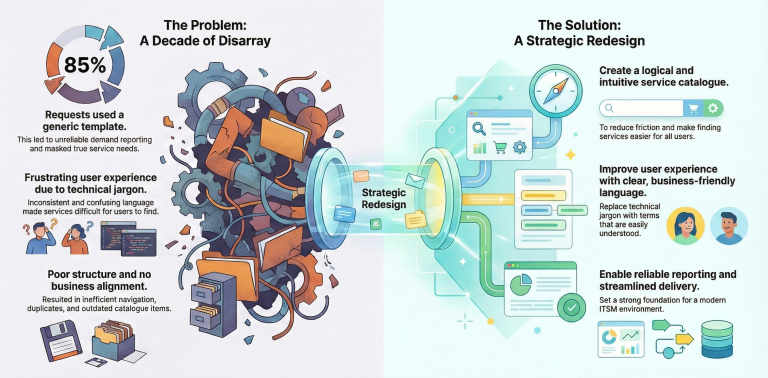
- Conducted a full catalogue review to identify outdated, redundant, and unused service items.
- Rebuilt the structure around logical business categories with customer-friendly language.
- Focused on request rationalisation, consolidated and standardised service items to reduce clutter and improve clarity.
- Introduced Governance Framework and standards plus templates to control future catalogue growth.
- Ran workshops and demos to validate improvements and secure adoption across teams
Results at a Glance
- Reduced request items by 60%, eliminating redundancy and improving navigation.
- Improved user satisfaction by creating an intuitive, business-friendly catalogue.
- Enabled faster request fulfilment through better categorisation and clearer definitions.
- Restored meaningful reporting on service demand by reducing generic requests.
- Laid the groundwork for future ServiceNow modernisation.
- Introduced a governance model to maintain catalogue integrity over time.
My Role & Insights
My Role:
As the lead manager for this initiative, I guided the team through auditing the existing request catalogue, identifying structural issues and redundancies. I led the collaborative design of a new logical structure and service categories, helped define business friendly naming conventions, and shaped standardised templates. I facilitated stakeholder workshops, demos, and feedback sessions to ensure alignment and adoption. I also governed the integration of the new catalogue into future ServiceNow development, transforming a decade of technical debt into a streamlined, customer focused Service Request Catalogue.
Key Insights
- A deep audit is essential before any redesign as assumptions miss hidden complexities.
- Business language is not optional it is critical for user adoption.
- Early and frequent stakeholder engagement minimises resistance and speeds adoption.
- Governance must be embedded from the start to prevent future technical debt.
- A large consultancy was engaged but lacked internal organisational context, often making broad assumptions. My hands-on guidance helped correct scope drift, realign priorities, and bridge cultural understanding, ensuring the solution was tailored, not templated.
- The catalogue must evolve with the business; it is a living asset, not a one-time deliverable.
© 2025 itservicemgmt.com. All rights reserved. Case studies and content are proprietary and confidential. Reproduction or distribution without written permission is prohibited