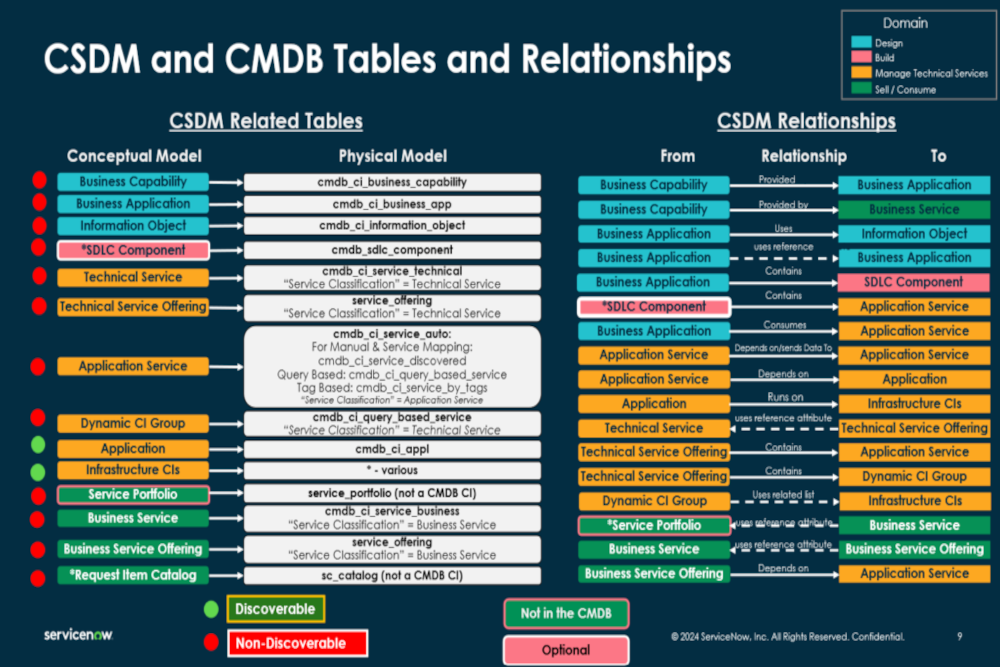
Adopting the Common Service Data Model (CSDM) often feels like a big commitment, yet many teams I’ve worked with over the years end up wishing they had started sooner once they start seeing results. The model gives a standardised way to structure services, applications, and infrastructure items, which directly tackles the messy data problems that plague most instances.
I’ve been working with the Common Service Data Model since version 2, and it’s fair to say the early ServiceNow documentation left a lot to be desired. It certainly wasn’t plug-and-play. You couldn’t pick up the guide, follow it step by step, and come out with a clean implementation. Even by version 4, plenty of areas remained confusing or contradictory, and many of us spent months unpicking inconsistencies that simply didn’t make sense in real-world environments.
The good news is that a lot of the pain points teams like mine encountered, the unclear relationships, the overlapping domains, the guidance that conflicted with out-of-the-box behaviour, fed directly into the improvements we now see in version 5. The current model is significantly clearer, more prescriptive where it needs to be, and far better aligned with how organisations actually structure their services. It feels like the framework has finally matured into something you can realistically build on without constant second-guessing.
How CSDM Sharpens Incident and Change Impact Analysis
When relationships between business services, application services, and the underlying configuration items are clearly defined, impact assessment becomes far more reliable. Teams can quickly see which services an incident might affect or what risks a proposed change carries. In practice, this means shorter outages and fewer surprised stakeholders because the data finally reflects reality rather than a collection of custom tables built years ago.
Smoother Upgrades and Less Accumulated Technical Debt
One of the biggest headaches for long-term ServiceNow customers comes at upgrade time. Heavy customisations outside the standard model often break, cost a fortune or require expensive rework. Sticking close to CSDM reduces those custom layers, so new releases install with far fewer conflicts. I’ve seen platform owners breathe easier knowing they won’t face another “zBoot” exercise to clean up years of drift.
Building a Shared Language Across Teams and Products
Different groups in the same organisation frequently describe the same assets in completely different ways. Finance might talk about cost centres, operations about servers, and service owners about offerings. CSDM forces a common structure and vocabulary that spans ITSM, ITOM, ITAM, and other modules. The result is less duplication and a genuine single source of truth everyone can trust.
Clearer Links Between IT Work and Business Outcomes
Executives rarely care about servers or switches; they care about the capabilities those assets support. CSDM maps technical components up to business capabilities and services, creating end-to-end visibility. This alignment helps IT leaders show exactly how technology spend ties to business results, which proves invaluable during annual IT budget discussions or prioritisation meetings.
Preparing Your Data for AI and Automation Features
ServiceNow continues to roll out AI-driven tools such as Now Assist and predictive intelligence. Those features work best when the underlying data follows a predictable pattern. Teams that align with CSDM find they can turn on new capabilities quickly without first embarking on a major data-cleanup project. Clean, structured data remains the foundation for meaningful automation.
Reliable Reporting That People Actually Use
Inconsistent modelling leads to reports that never quite match across departments. Once CSDM is in place, dashboards on service health, performance, and costs become consistent and trustworthy. Leaders stop arguing about whose numbers are right and start using the insights for planning and root-cause work.
Speeding Up Larger Initiatives Like TBM Implementations
Technology Business Management (TBM) projects often drag on because mapping costs to services takes forever in a non-standard environment. You can cut the time from for-ever across a multi-year TBM rollout down to weeks simply by using CSDM as the backbone. The standardised hierarchy makes cost allocation, chargeback models, and financial transparency far more straightforward.
Stronger Governance and Risk Oversight
Tracking vulnerabilities, software licences, or third-party risks requires dependable dependency information. CSDM provides the structure needed for accurate audits and better security decisions. It also simplifies compliance reporting because ownership and relationships are explicit rather than buried in custom fields.
Lower Long-Term CMDB Maintenance Burden
Many teams underestimate how much effort a CMDB demands over time. Following CSDM guidance keeps the data healthier from the start, so ongoing cleansing, integration updates, and reconciliation work shrink noticeably. The model encourages practices that prevent drift, saving considerable effort down the line.
CSDM Concepts Beyond ServiceNow
Even organisations not fully committed to ServiceNow benefit from studying CSDM. Version 5.0 offers a vendor-neutral framework for defining service hierarchies and domains that works across tools. Teams using mixed environments find the common lexicon helps integration planning and reduces silos when different platforms handle discovery, monitoring, or development.
My experience shows that the real value appears gradually as data quality improves and processes stabilise. Teams rarely regret moving toward the model; they more often regret waiting.
FAQ Questions
Is CSDM mandatory for ServiceNow customers?
No, ServiceNow does not force anyone to follow CSDM. Many instances run perfectly well without it, though adopting the model tends to pay off once you start using multiple products or advanced features.
How long does a typical CSDM alignment project take?
It varies widely depending on instance age and complexity. Smaller or newer instances might need a few months, while large, heavily customised ones often require phased work over a year or more.
Does following CSDM limit customisation options?
It steers you toward out-of-the-box structures, which can feel restrictive at first. In return, you gain easier maintenance and upgrade paths, and you can still add controlled extensions where genuinely needed.
Can CSDM help with Technology Business Management (TBM)?
Yes, the standard service hierarchy maps directly to TBM taxonomy. Organisations frequently report much faster cost-to-service mapping and more accurate financial reporting after alignment.