Achieving $1.5 Million in Savings
Global Organisation | Hybrid Support Model, Exceeded Savings Target, Maintained Reliability


Executive Summary
Following the 2014 iron ore price collapse and a company-wide $5 billion cost-saving initiative, I led a critical project to curb escalating network maintenance expenses across a vast global infrastructure supporting remote operations. A detailed global CMDB audit revealed a projected 229% cost increase due to hundreds of untracked assets, making traditional Cisco-only support unsustainable.
I designed and implemented a hybrid support model retaining Cisco coverage for mission-critical assets while shifting appropriate infrastructure to qualified third-party vendors. This balanced operational risk with aggressive cost reduction Through contract analysis, asset criticality mapping, competitive RFP processes, flexible negotiations, robust escalation protocols, and extensive stakeholder engagement (IT, Operations, Finance), the model was successfully rolled out.
The initiative exceeded its $1.5 million savings target over three years with zero disruptions to network reliability. Improved CMDB accuracy eliminated future surprises, and the hybrid framework became a sustainable standard for network maintenance. This project proved that substantial IT cost savings are achievable in high-stakes environments when grounded in accurate visibility, careful risk management, and cross-functional alignment.
The Challenge
- A company wide $5 billion cost saving drive triggered by a collapse in iron ore prices, led to required cost saving intiatives
- Unregistered network assets in the CMDB led to a 229% increase in expected maintenance costs
- Legacy reliance on full Cisco support across everything proved financially unsustainable at this time.
- Resistance to third-party vendor models due to operational risk concerns
- Needed to ensure reliable support for remote mining operations without introducing new risks
- Aligning diverse stakeholders across IT, Operations, and Commercial teams was a must for buy-in
The Solution
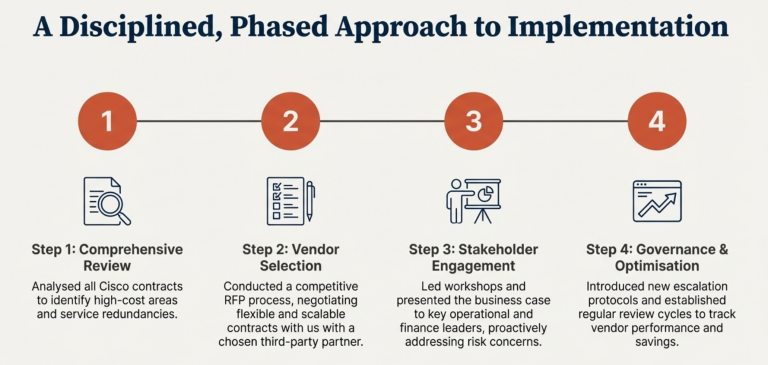
- Analysed Cisco contracts to identify high-cost areas and redundancy
- Partnered with IoT infrastructure teams to prioritise assets for OEM vs third-party support based on correct criticality
- Built a hybrid strategy combining Cisco support for critical assets and third-party maintenance for others
- Conducted a competitive RFP process and negotiated flexible, scalable contracts
- Introduced escalation protocols and structured asset management to support the model
- Led workshops and communication sessions with key operational leaders and finance teams
- Addressed concerns proactively through risk assessments and business case presentations
- Established review cycles to track vendor performance, savings realisation, and operational impacts
- Updated the CMDB to ensure better asset visibility and lifecycle tracking (Separate Project)
Results at a Glance
- Exceeded $1.5M savings over three years
- Zero disruptions and critical assets protected
- Improved CMDB accuracy which reduced future risks
- Sustainable hybrid framework provided long-term cost efficiency
- Embedded a flexible, cost-efficient model for sustainable network maintenance
- Strong stakeholder trust which aligned IT with business goals
My Role & Insights
My Role:
As Service Manager, I was accountable for leading this critical initiative end-to-end. I drove the review and analysis of network maintenance contracts, designed the hybrid support strategy, and managed vendor negotiations. I led cross-functional collaboration across IT, Operations, and Finance teams, oversaw stakeholder communication, risk mitigation, and change management, and ensured successful implementation, performance monitoring, and long-term sustainability. This work demonstrated the power of balancing innovation with operational needs, delivering measurable savings while protecting core business outcomes.
Key Insights
- Maintaining an accurate, living CMDB is essential to avoid hidden costs
- Breaking OEM dependency requires careful change management and vendor selection
- Early communication and operational alignment builds trust in new support models
- Long-term cost management must account for post-implementation support realities
- Strategic third-party partnerships can strengthen, not weaken, operational resilience
© 2025 itservicemgmt.com. All rights reserved. Case studies and content are proprietary and confidential. Reproduction or distribution without written permission is prohibited